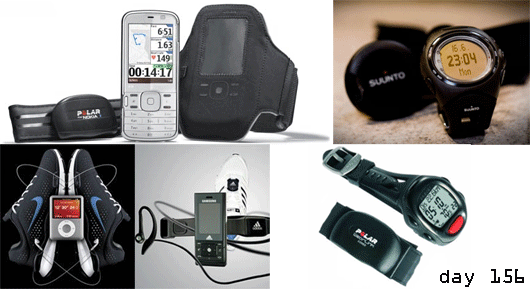
Part V: Eventually, the bigger picture. How does the new Nokia N79 Active package fit into the larger landscape of more or less intelligent training companions. The selection might not be exhaustive, but the point is to provide a target group overview based on the product proposition. The analysis can easily be extrapolated to other existing products on the market.
Let’s use two major dimensions in the product offering. One being the sports functionality and the other entertainment+community features. Sports functionality are the more traditional physical workout data input capabilities, training data representation during the session and afterwards, plus data analysis tools. All those things pro, semi-pro and wanna-be pro athletes want to have. Entertainment and community features are more the new kids on the block. Those are e.g. the addition of playing music, listening to the radio, taking pictures/video, live sharing during the workout session. And post-session web service community interaction around the workouts and the recorded data (e.g. physical workout data, geotagged data and multimedia), such as telling your buddy that he’s a total show-off.
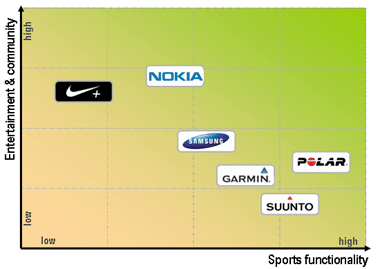 The diagram on the left shows how the different product propositions are positioned relatively to each other. This is not a highly analytical research result, but rather the qualitative assessment from reading reviews on the different products. One factor is left out, price, because it makes more sense to save a little more to get the better matching product than buying a training companion just because it’s cheap.
A brief walkthrough of the different products, their characteristics and why they’re in its place on the map.
Nike+: A motivating running aide that spurs you on with voice feedback and the ability to sync to a website, no Mac SW problem, that’s good. Works with an iPod Nano right now. All very simple, candy shop colorful and easy-to-use, nice widgets of friends that you can integrate into your own Nike+ site and challenge for a next workout. Perhaps a bit too simple on the sports functionality side, there’s no heart rate monitor functionality and no placing the route on a map afterwards. A Nike shoe specific (although you can attach it to other shoes with a bit of tape) accelerometer measures your stride and thus the speed and distance. For more info read a good review on a blog on stuff.tv or sheck out the flashy Nike+ web site.
Nokia N79 Active: What’s there still to say that hasn’t been said already in last weeks’ blog entries. The inbuilt GPS, the Sports Tracker application and Polar heart rate belt covering the sports functionality aspects and the good camera, ample of GB (I use an 8GB memory card) for music and the Sports Tracker service looking after entertainment & community features with route maps etc. The only critical thing that the competitive athlete misses is the wrist unit. With the device sitting on the upper arm is not easy to catch just the data you need in full running speed. For cycling this is different, since you would mount it on the handle bar. See the full spec in part I
Samsung/Adidas miCoach: This is actually a co-operation between Samsung and Adidas, which underscores the more athletic and performance aspects of the proposition. You find a whole array of running plans that lays out your training for weeks and months. A female coach voice spurs you on while out there. And the associated web service is purly training result and analysis focused, no community features. Music you can play from the Samsung F110 handset, but as reviews say it’s fiddly and hence not well integrated into the Sports app. Nokia has nicely circumvented this by putting the music controls on the headset cable. Depending on how important music is for you the Samsung/Adidas combo is higher or lower on the entertainment/community scale. More info on the same blog on stuff.tv or the nice miCoach webiste.
Garmin: Taking the Forerunner 405 as Garmin representative, it has a wrist unit with GPS and a heart rate monitor, which places it right away closer to the Polar and Suunto guys. The display is clean and well readible and the wrist unit has a novel input method, a bezel around the display. Of course there are no music, camera or other handset entertainment feature. A PC software comes along (sorry Macs, apparently PC only) that helps with the link to the web service. The web service features a Google Map, different performance views and a very thin community offering (there’s a share button somewhere), but it seems that Garmin hasn’t quite sorted out what that should be good for. The reason for the 405 being not quite equal with Suunto and Polar on the sports functionality axis is due the lack of depth in workout data analysis. For more details here Garmins web shop and here a review of the 405.
Suunto: Now we are at the competitive training companion forefront. The difference to Polar is not much sports wise. Some reviews pointed out that the Suunto tc6 is a simplified Polar S625x, but with simplification in the positive sense. Well, it seems to come ot personal taste and what data you need. The PC software (again no word on Mac support) apparently isn’t as smooth as Polar’s and there’s no web service included. For more details the conclusion of a lengthy review and the Suunto heart rate monitor web site.
Polar: Finally the market leader in competitive sports oriented heart rate monitors (and most probably also in the fitness area). We’re using the Polar S625x ourselves for this 400days project and see why it’s top. The relevant data is generated from the wrist unit, the GPS or accelerometer foot pod and the heart rate monitor. The PC software (again no Mac support) is the offering a plethora of analysis functionality. Further the Personaltrainer.com service is the community and motivational web service. Just registered to try it out. For more info the same conclusion page of the lengthy review and the Polar web page.
How important are the sports and performance aspect and how important the entertainment and community aspects are for you? We’re using two systems right now. Yes, it feels sometimes like turning into a terminator with all the attached technology. But the Polar is needed for all the analysis features and the Nokia N79 Active for getting some entertainment while out there on a 20+k run. Plus with more and more friends and colleagues on the Sports Tracker service, the community is becoming fun. Although in the long term this should be part of a larger community platform, OVI if Nokia does it themselves or Facebook if someone does an integration.
Part I: the nokia n79 active, a runner’s companion
Part II: nokia n79 active, out of the box
Part III: nokia n79 active, experiences of the nokia running man
Part 3.5: nokia n79 active and polar s625x, becoming a humanoid
Part IV: Nokia N79, out for a test drive
Tags: Adidas miCoach, Garmin, Garmin Forerunner 405, Nike +, Nokia N79 Active, Polar, polar s625x, Samsung miCoach, Suunto, Suunto tc6







Leave a Reply
You must be logged in to post a comment.